
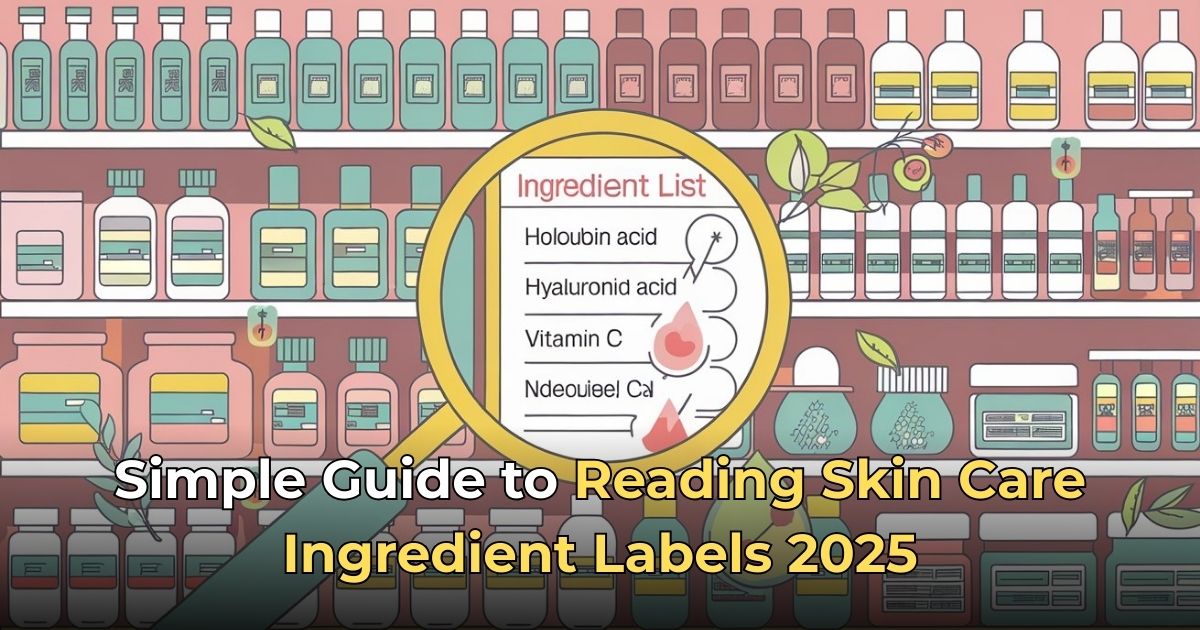
You don’t need a chemistry degree to know if a product is good for your skin. You just need to know the 10 rules below. After reading this once, you’ll walk into any store or scroll any website and instantly know whether a cleanser, serum, or moisturiser is worth your money - or your face.
Rule 1 - Ingredients are listed from highest to lowest concentration
The first 5-7 ingredients make up ~80-95 % of the product. If water is #1 and your “hero” ingredient (niacinamide, retinol, hyaluronic acid) is #18 → it’s basically flavoured water.
Rule 2 - The 5 most common #1 ingredients (and what they really mean)
- Water / Aqua - Normal and good. Most products are 60-80 % water.
- Glycerin - Amazing humectant (pulls water into skin). Great #1 or #2.
- Butylene Glycol / Propylene Glycol / Pentylene Glycol - Lightweight humectants + help actives penetrate. Safe and useful.
- Dimethicone / Cyclomethicone - Silicones. Give slip and temporary smoothness. Fine in rinse-off or light layers; avoid heavy layers if you’re acne-prone.
- Mineral Oil / Petrolatum - Old-school occlusives. Excellent for very dry or eczema skin; comedogenic for oily/acne skin.
Rule 3 - The 7 ingredients to avoid if you want healthy skin in 2025
- Denatured Alcohol / Alcohol Denat / SD Alcohol (high on list) → dries and irritates
- Fragrance / Parfum (unless clearly marked “essential oil blend”) → #1 cause of allergic reactions
- Parabens (only if you’re sensitive; most modern ones are safe)
- Sulphates (Sodium Lauryl Sulphate, Sodium Laureth Sulphate) in leave-on products
- Synthetic dyes (FD&C Red No.40, Yellow No.5)
- Methylisothiazolinone / Methylchloroisothiazolinone → strong sensitisers
- Heavy mineral oil in face products if you’re oily/acne-prone
Rule 4 - The 15 hero ingredients worth paying for (and where they should appear)
Look for these in the first 8-10 spots:
| Ingredient | What it does | Ideal position |
|---|---|---|
| Niacinamide | Pores, oil, redness, barrier | Top 5-10 |
| Hyaluronic Acid (any MW) | Instant + long-term hydration | Top 10 |
| Centella Asiatica | Calming, healing, anti-inflammatory | Top 10 |
| Ceramides (1,3,6-II) | Repair skin barrier | Top 10 |
| Panthenol | Soothing + hydration | Anywhere |
| Allantoin | Calms irritation | Anywhere |
| Retinol / Retinal / Granactive Retinoid | Anti-aging, acne, texture | Top 10-15 |
| Vitamin C (L-Ascorbic 10-20 %, derivatives) | Brightening, collagen, antioxidant | Top 5-10 |
| Peptides (Matrixyl, Argireline, Copper) | Firming, wrinkle reduction | Top 10 |
| Snail Mucin | Hydration + repair | Top 5 |
| Squalane | Lightweight moisture lock | Top 10 |
| Bakuchiol | Retinol alternative | Top 10 |
| Alpha-Arbutin / Kojic Acid | Fading dark spots | Top 10 |
| Salicylic Acid (BHA) | Acne, blackheads, oil control | Top 5-10 |
| Azelaic Acid | Rosacea, acne, pigmentation | Top 10 |
Rule 5 - The “water bomb” trick (Korean skincare secret)
If the first 6 ingredients are: Water → Glycerin → Butylene Glycol → Pentylene Glycol → Betaine → 1,2-Hexanediol → you’ve found a hydration beast. Add any active lower down and it will penetrate beautifully.
Rule 6 - How to spot a true “clean” vs marketing “clean”
Real clean: short list, recognisable plant names, no fragrance, no dye. Fake clean: 40-ingredient list with “natural” on the front but fragrance, PEGs, and phenoxyethanol inside.
Rule 7 - The 4 types of preservatives you’ll see (and which are gentle)
- Phenoxyethanol - Safe up to 1 %, most common gentle preservative
- Ethylhexylglycerin - Very gentle, often paired
- 1,2-Hexanediol / Caprylyl Glycol - Super gentle, K-beauty favourite
- Radish root ferment / Leuconostoc - Natural, great for sensitive skin
Rule 8 - pH matters more than you think
- Cleansers: ideal 5.0-6.0
- Vitamin C serums: 3.0-3.5 for L-ascorbic (if higher → useless)
- Exfoliants (AHA/BHA): 3.2-4.0 Anything called “toner” at pH 8+ is just expensive water.
Rule 9 - The “fragrance loophole” almost every brand uses
“Fragrance / Parfum” can legally hide 100+ chemicals (including phthalates and allergens). If it says “essential oil blend” and lists lavender oil, citrus oil, etc. → safe and transparent.
Rule 10 - Quick 60-second label test you can do in-store
Step 1: Find your hero ingredient → is it in top 10? Step 2: Scan for alcohol denat or fragrance in top 10 → put back if yes Step 3: Look for dimethicone → okay for dry skin, skip for oily Step 4: Check last 5 ingredients → if it ends with dye or heavy fragrance → no Pass all 4 → buy.
Real Examples - 2025 Bestsellers Decoded
The Ordinary Niacinamide 10 % + Zinc 1 % Water, Niacinamide (2nd!), Zinc PCA, humectants → 10 % real niacinamide. Excellent.
CeraVe PM Facial Moisturizing Lotion Water, Glycerin, Niacinamide (#5), Ceramides (#9-11), Hyaluronic Acid → barrier repair dream.
Drunk Elephant C-Firma Fresh Day Serum Water, L-Ascorbic Acid (#2 at 15 %), Ferulic, Vitamin E → real vitamin C power.
La Roche-Posay Toleriane Hydrating Cleanser Water, Glycerin, gentle surfactants, niacinamide, ceramide → perfect gentle cleanser.
A $120 “luxury” cream that failed Water, Dimethicone, Alcohol Denat (#4), Fragrance (#8), Peptide (#22) → marketing scam.
Your New Shopping Checklist (Print or Screenshot)
- Hero active in top 10
- No drying alcohol in top 10
- No mystery “fragrance” in top 10
- Contains at least 2-3 skin-identical ingredients (ceramides, fatty acids, cholesterol)
- pH-appropriate for the claim (if possible to check)
- Preservatives are gentle (phenoxyethanol <1 %, hexanediol, etc.)
Final Thoughts
Reading labels is the difference between guessing and knowing. You now have the exact decoder ring every dermatologist and formulator uses.
Next time you pick up a bottle, you’ll know in 30 seconds whether it’s a $12 hero or a $120 scam. Your skin (and wallet) will thank you for the rest of your life.
Bookmark this guide. Share it with your group chat. Never waste money on pretty packaging again.